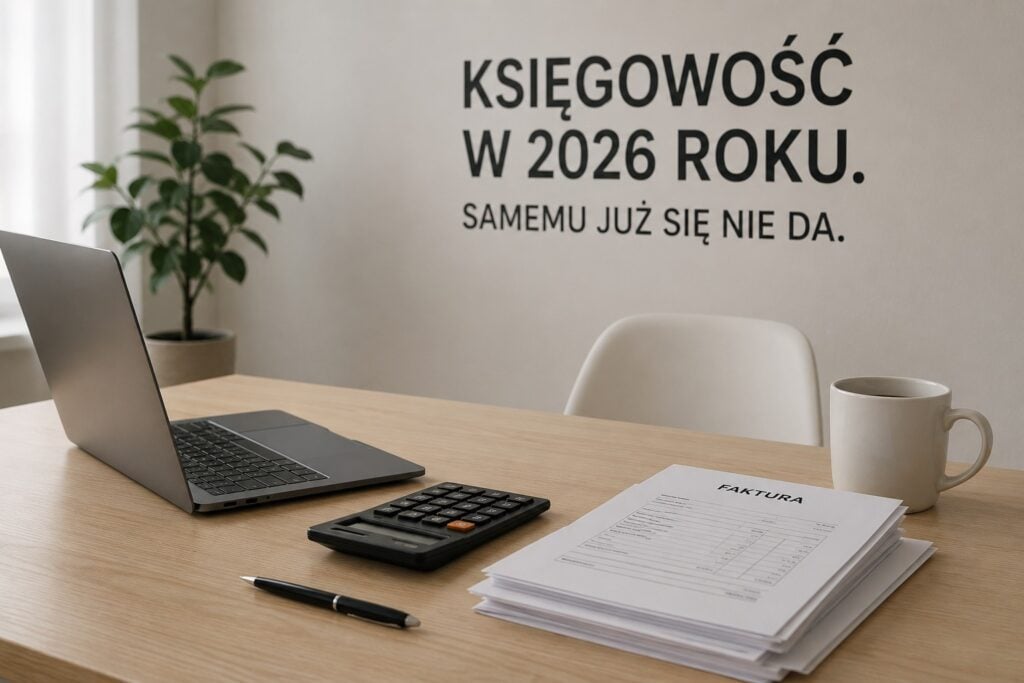
Just a few years ago, many entrepreneurs did their bookkeeping “as an aside.” Issuing a few invoices, entering costs into a program, and submitting a VAT return seemed like a breeze. Today, however, the reality is completely different.
The year 2026 demonstrates this very clearly: independent accounting is becoming increasingly difficult, riskier, and simply time-consuming. It’s not because entrepreneurs are less competent. It’s simply because regulations, systems, and obligations are changing faster than ever before.
Accounting is no longer just about “entering invoices”
Many people still think that accounting is primarily about recording documents. However, modern business management today is a combination of:
- tax regulations,
- commercial law,
- electronic reporting,
- deadline control,
- interpretation of changing regulations,
- tax risk analysis,
- online systems support,
- contacts with offices,
- KSeF, JPK, ZUS, e-Tax Office and many other obligations.
Added to this are constant amendments. Entrepreneurs who want to manage their own accounting today must not only be familiar with the regulations but also constantly monitor their changes and understand the tax consequences of their decisions.
KSeF changed everything
One of the biggest breakthroughs in recent years is the mandatory National e-Invoicing System. The National e-Invoicing System isn’t just a “new way of issuing invoices.” It’s a complete overhaul of our approach to document flow and tax auditing.
In practice, this means, among other things:
- the need to issue invoices correctly in accordance with the structure,
- monitoring shipment statuses,
- handling technical errors,
- granting permissions,
- system integration,
- deadline control,
- responsibility for the correctness of data sent to the tax administration.
Just a few years ago, an entrepreneur could correct an error “after some time.” Today, much data enters systems almost immediately.
Regulations are changing faster than companies can keep up
In recent years, entrepreneurs have had to navigate changes including:
- health insurance contributions,
- Polish Order,
- new depreciation rules,
- minimum income tax,
- electronic reporting,
- VAT changes,
- new obligations of companies,
- DAC7,
- personnel and payroll changes,
- increasing documentation obligations.
The problem is that most business owners don’t have time to analyze tax rulings in the evenings after work. And it’s no wonder—entrepreneurs should be growing their business, not checking daily for changes in the law.
Invoicing software will not replace an accountant
More and more ads promise “5-minute accounting” or “full automation.” However, the reality is different.
The program can:
- issue an invoice,
- remind you of the deadline,
- automatically post a simple document.
But the program:
- will not assess tax risk,
- will not suggest the best form of settlement,
- will not notice an error in the contract,
- will not explain the effects of the inspection,
- will not take responsibility for the interpretation of the regulations,
- will not predict the consequences of a specific business decision.
Technology helps, but does not replace experience and knowledge.
Independent accounting often “works”… until the first problem
Many entrepreneurs manage their accounting independently for months or even years without any major problems. The challenges usually begin when:
- control,
- summons from the office,
- error in VAT,
- problem with a contractor,
- incorrectly settled foreign sales,
- company,
- employees,
- leasing,
- fixed assets,
- corrections,
- arrears from previous years.
Then it turns out that seemingly minor errors can cost much more than professional accounting services.
Good accounting means company security today
In 2026, an accounting firm is no longer just an “expense.” It is increasingly becoming a partner that helps entrepreneurs:
- avoid mistakes,
- plan taxes,
- keep an eye on deadlines,
- interpret regulations,
- organize documents,
- prepare your company for inspections,
- implement new responsibilities,
- run your business calmly.
The greatest value of good accounting today isn’t just the recording of documents. It’s the sense of security it provides.
Is it still possible to do accounting on your own?
In very simple activities, sometimes yes. But even then, it requires increasing knowledge, time, and responsibility.
The more a company grows, the more accounting ceases to be an add-on and becomes one of the key areas of business management.
And that is why in 2026, more and more entrepreneurs are coming to the same conclusion:
You really can’t do it alone anymore.